The Pothohar Association UK · Voices from the Villages
What Was Left of Bewal
A family account of Bewal in Rawalpindi District and the violence of March 1947
Dr Peter Chadha · Vice President
Bewal · March 1947
Estimated total villagers
The date used in the existing accounts
A rounded figure used to show the scale
With additional deaths elsewhere in Bewal
The figure recorded in the account
Of the survivors – approximately 38 people
Caveat. These rounded figures are intended to convey the scale. The total village population is an estimate; other figures come from the accounts, whose precise totals vary.
November 2017
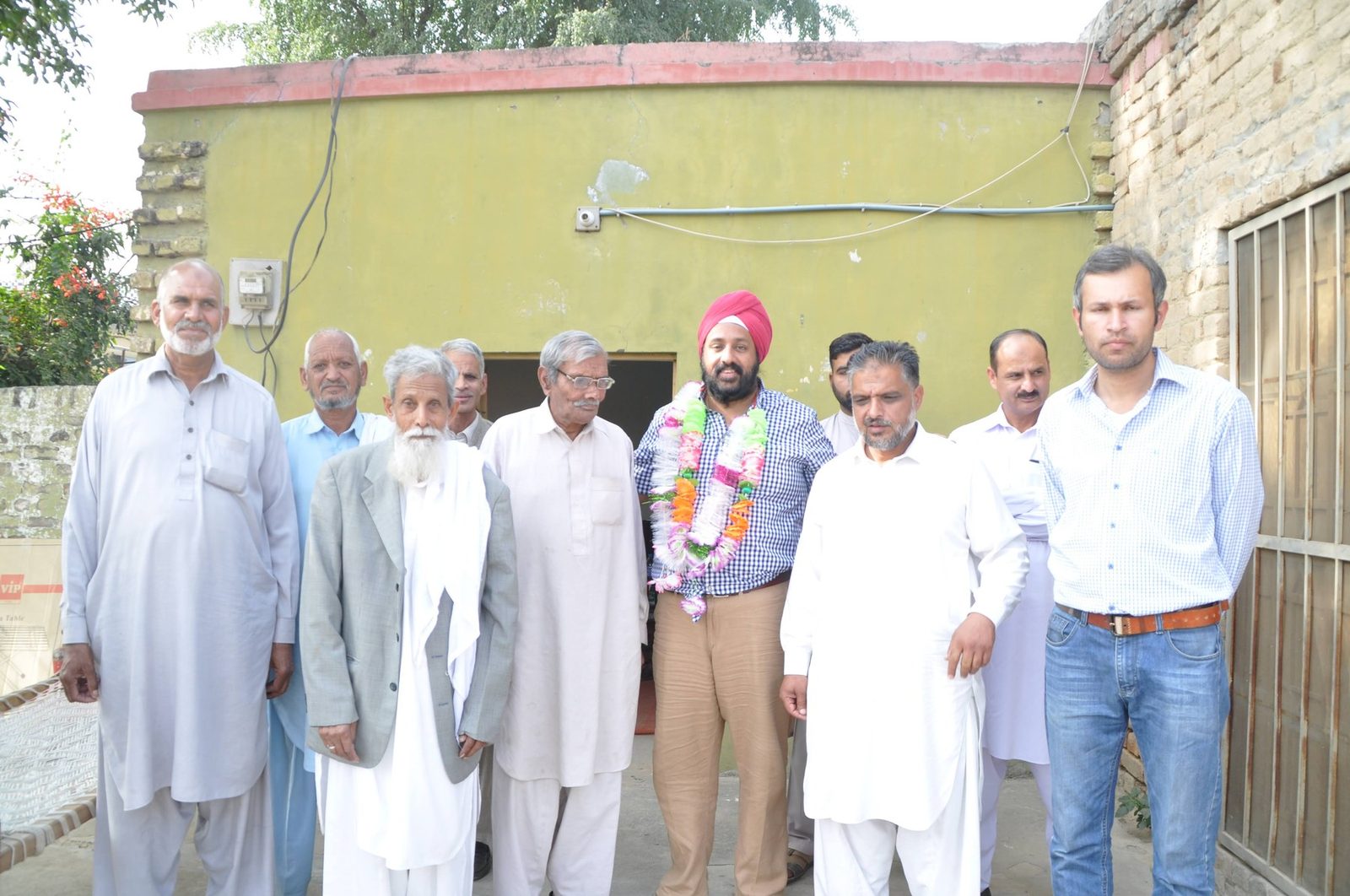
I went back to Bewal with the Pothohar Association in November 2017. I am the one in the turban. The photograph was taken outside a modest house in the village – yellow walls, a courtyard, the sort of place where people still come out when a van arrives from somewhere else.
It was not the Gurdwara. I need to be precise about that, because I was not, at the time. The house belonged to the older man standing next to me in glasses. His family had been our tenants. He knew of my great-grandfather and the household. Seventy years after the village was emptied of its Sikhs and Hindus, that memory remained.
They received us with a humility that is easy to write as a line and harder to describe if you were actually there. They gave us refreshments. They put a garland on me. They spoke as if the old family had merely been away. Terrible things were done in 1947, when human beings were driven into the basest behaviour. That does not define the Muslim residents I met in Bewal in 2017. They were gracious and welcoming. Both truths belong in the same account.
Bewal, in Gujar Khan Tehsil, had been my father’s village. I knew the name the way Pothoharis know names – as something carried, not as a place you could still walk into. I did not yet know what had been done at the Gurdwara. That came later, which is why this is a journey of discovery and not a pilgrimage I was already qualified to make.
The Gurdwara
When I asked for a loo, villagers directed me to a substantial villa-type house because it was regarded as one of the best houses in Bewal. It was a proper place, with marble, and far grander than the modest house in the photograph. I went into it. I used the loo. I had no idea that it stood on the former Gurdwara site.
I used the loo. I had no idea.
That is the sentence I have been circling since I started asking questions. In 2017 I walked through a house on the ground where, on 10 March 1947, approximately 500 Sikhs and Hindus who had taken shelter in the Gurdwara were burned alive, with further deaths elsewhere in Bewal. I was looking for a lavatory. The history was already in the records. It was not yet in my head.
Bewal had been a prosperous village, though prosperity in Pothohar does not look like a flat English farm. This is the Pothohar Plateau, toward the Himalayan foothills, and the land undulates. People held parcels here and there – orchards, small plots and cultivation fitted to the slopes – rather than a single western holding behind one fence. The wider region is also associated with the Salt Range and its pink rock salt, a useful landmark for readers trying to place this country in the mind.
The household
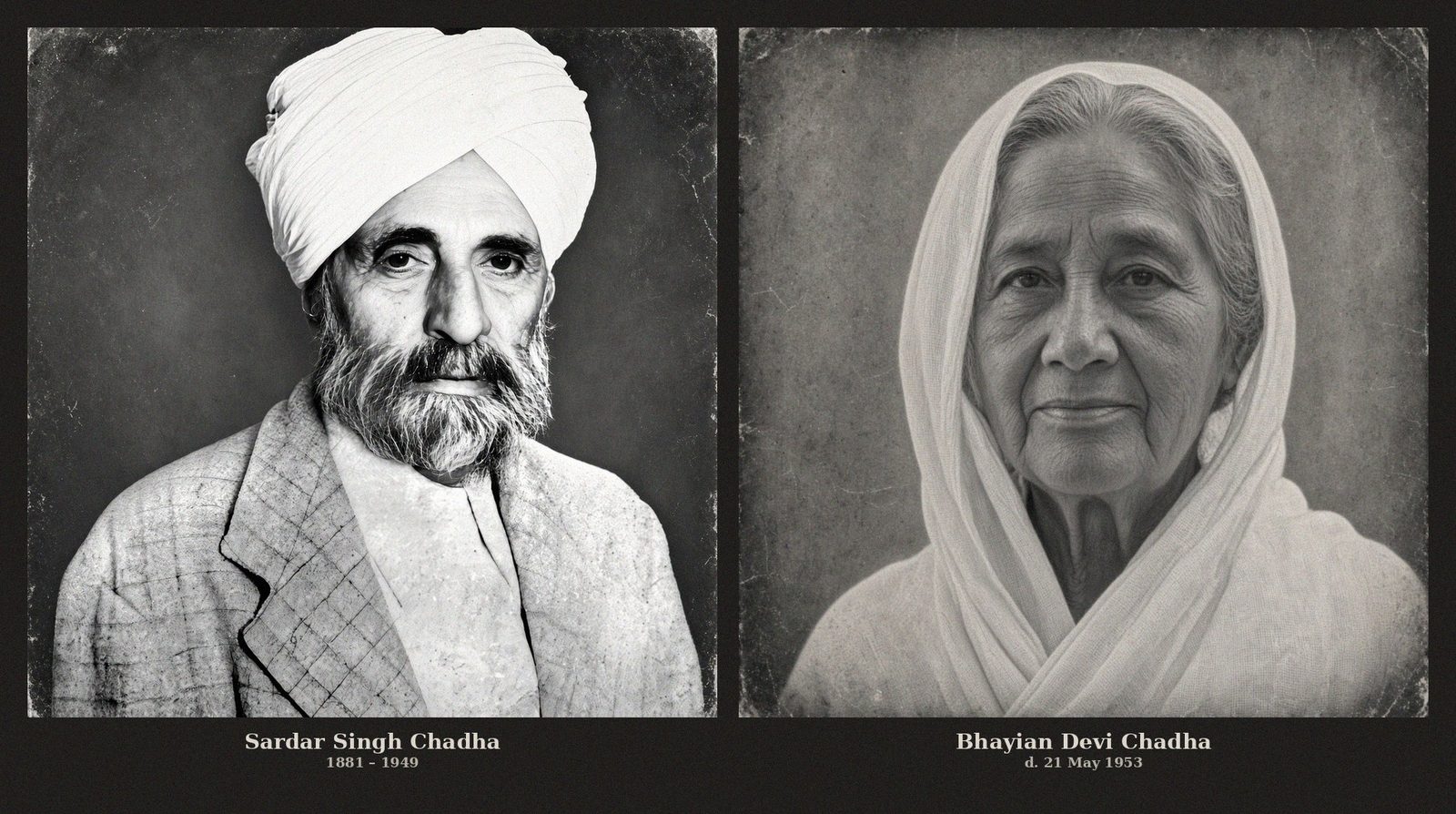
The heads of the household were my great-grandfather, Sardar Singh Chadha, and his wife, Bhayian Devi Chadha. He was born in 1881 and died in 1949, two years after the family had been forced out of the village. She died on 21 May 1953. We do not have her date of birth.
They were rural Khatris. Other branches of my family were more business-oriented, as many Khatri families traditionally were, but I understand this particular branch as having been more intellectual and service-minded in character. Sardar Singh was a landowner rather than primarily a businessman, and he was also the local hakeem: knowledgeable about herbs and traditional treatments, the person people went to when they were ill. It was not his full-time occupation. It was knowledge that made him useful to the village.
That service-mindedness is how the family remembered him, and it was a quality I also recognised in my grandfather, who gave much of himself to social service. I see something of Sikh ethics in it: seva expressed not as an abstract word but as care offered where it was needed.
Bhua Natho
Sardar Singh and Bhayian Devi had seven sons, of whom five lived, and two daughters, both of whom died. After losing their daughters, the household took in a poor Muslim girl remembered as Bhua Natho. They did not treat her as a servant or a charitable case. They treated her as an adopted daughter. To my grandfather and his brothers she was a sister; the word Bhua itself carries that family relationship.
Years later, the care shown to her became one of the threads by which the household survived. According to the first-hand family recollection of my aunt, now in her nineties, Natho learned that an attack was coming through her brother, remembered as Banko, who was involved with the local men organising the violence. Natho carried that warning to Bhayian Devi.
This is family testimony and I want to name it as such. It is not something I found in an official report. It comes from an elderly aunt who knew the history of this household first-hand. In our family, the account has always been that Natho warned the people who had made her their daughter and sister.
A few days before
Once you know what happened on that ground, the next question is not abstract. If that is what became of Bewal, why was this family not in the Gurdwara?
They left a few days before the attack. Not weeks. Not a planned migration with trunks and a date. A few days. The family moved to Gujar Khan, where there were relatives and the thin safety of a larger town. My grandfather had work waiting in Delhi, which later became a road to a life that did not have to be assembled from a refugee camp. Those facts look, in hindsight, like a design. They were not. They were the margin.
Had they delayed even a little, the story I would be writing – if I were here to write it – would be a list of names on a memorial, or no list at all. I exist to put the sentence down because a household walked to Gujar Khan a few days earlier. Gratitude, in the circumstances, is a blunt word. It will have to do.
What came in from outside
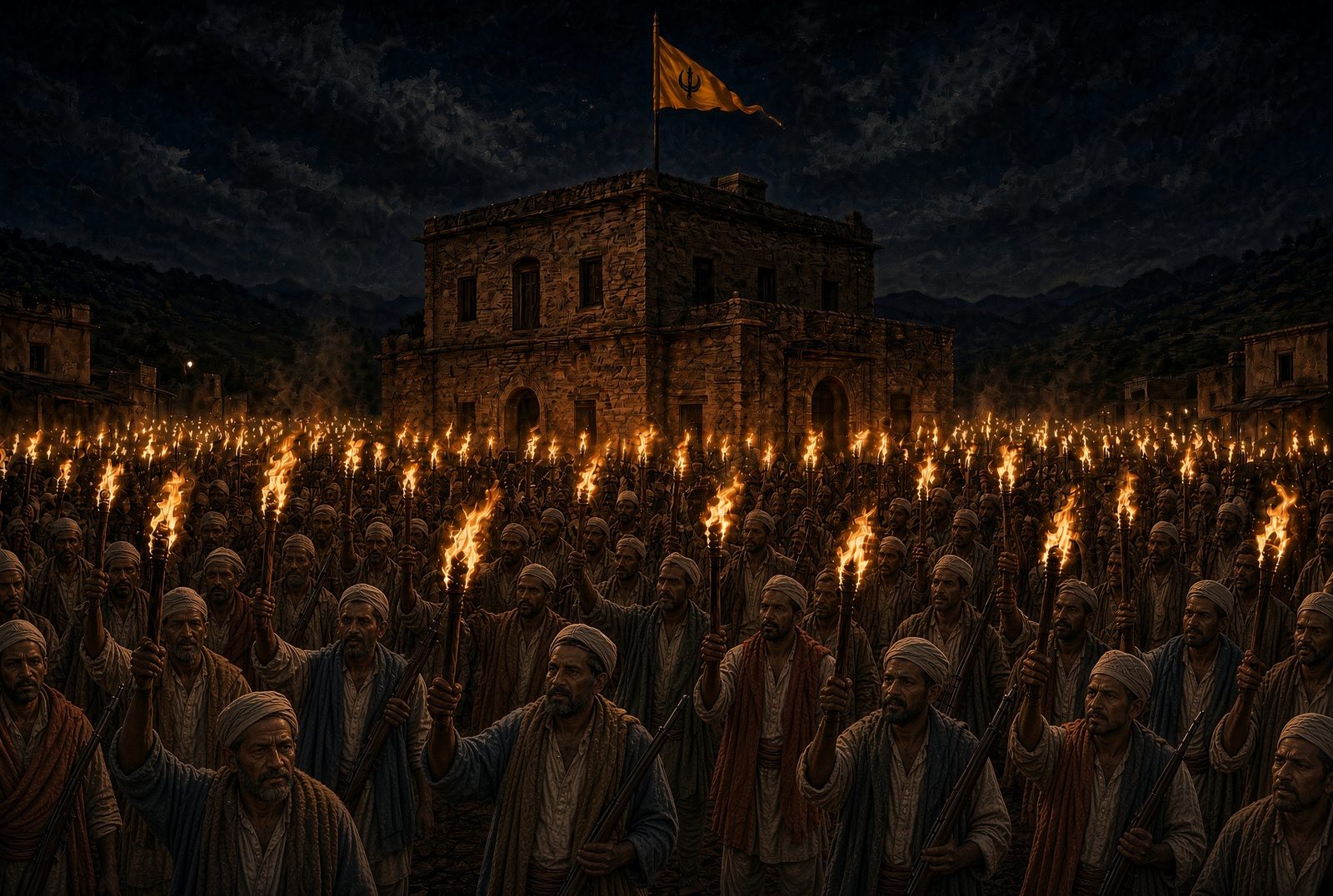
Bewal was one of the villages hit. It was not the only one. During the second week of March 1947 the same pattern moved across the Rawalpindi countryside – Thoa Khalsa, Kahuta, Duberan, Bewal and others – village after village that had been, until that week, a Sikh and Hindu place.
The violence did not rise from the few Muslim households inside Bewal. It came in from the surrounding countryside, organised and in numbers. Accounts vary over the figures, but the scale is not in doubt: approximately 500 people sheltered in the Gurdwara and were burned there, while other deaths occurred elsewhere in Bewal and the crowd outside was counted in the thousands. The accounts used here record 76 survivors, nearly half of them abducted rather than having escaped.
I understand from accounts and sources from the time that Muslim League activists and the Muslim League National Guards helped organise and fund much of the violence, with local organisers giving it shape and men from surrounding villages forming the attacking crowd. Recently demobilised soldiers, trained and sometimes armed from war service, were among those who led attacks across the district. Those who could took shelter in the Gurdwara. They were told to convert. The building was set on fire.
Contemporary reporting also records women and girls choosing death in the flames rather than capture. That is documentary material. Beside it sit the memories carried by families from Bewal, including my own and the written recollection of Ajit Singh Mahajan.
Another story from Bewal
A family fortune in a small bag
The story of Ishar Singh, recorded by Ajit Singh Mahajan
A memory recorded by Ajit Singh Mahajan, former General Secretary and committee member of the Pothohar Association
Ajit Singh Mahajan’s nanke – his maternal family – were in Bewal, and he knew the village from spending almost every school holiday there.
In those days banking and investment did not work for families in quite the way they do now. Gold and precious stones could carry wealth from one generation to the next: portable, durable and, even in a small bag, immensely valuable.
Ajit remembered that his cousin Ishar Singh, who owned a clothes shop in Bewal, held inherited diamonds and sapphires. He also wrote that, before Partition, Ishar had sold one diamond through their uncle, Justice Teja Singh of Kallar, for what Ajit called ‘a big amount’. For a modern reader, describing that one stone as representing tens of thousands of pounds today gives a sense of scale. It is contextualisation, not an exact valuation recorded by Ajit.
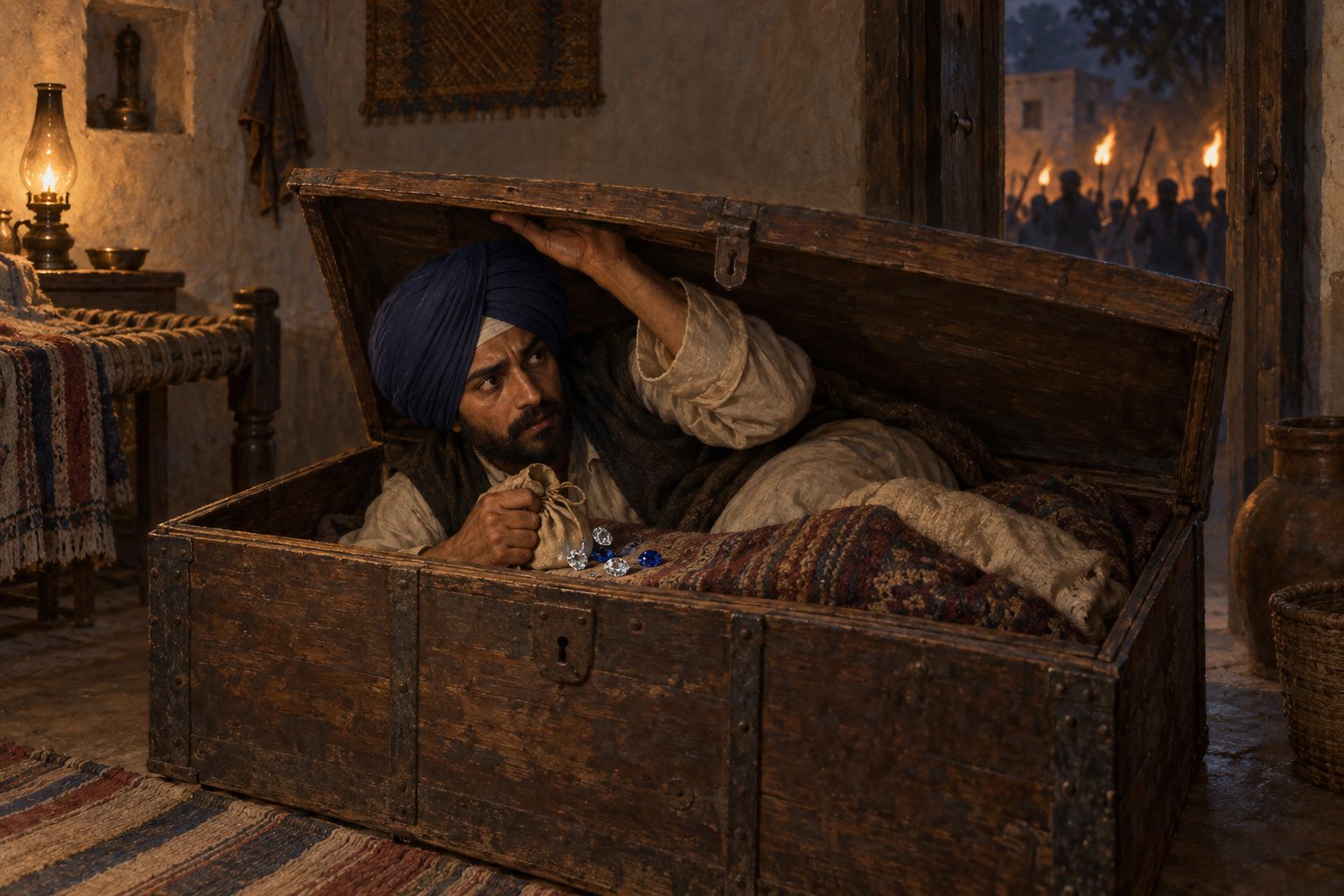
When Bewal was attacked, Ishar stayed in his house and lay down inside a large trunk of the kind used to store bedding. He pulled down the flap as the mob entered. They opened the trunk and found him.
Ishar begged for his life and handed over the bag of valuables. He told the attackers that, by selling its contents, they and their families would become rich. Ajit’s memoir records their answer: they would take the bag and kill him as well. They murdered him.
Ajit’s memoir also remembers armed resistance and says that defenders killed many of those who came to attack. I mention that because Bewal was not simply passive. People resisted with what they had. It did not alter what finally happened to the village or to Ishar Singh.
I learned all of this after I had already been in the house. That is the peculiar humiliation of inherited history: the documents were waiting. I was the one who arrived late.