
March not August
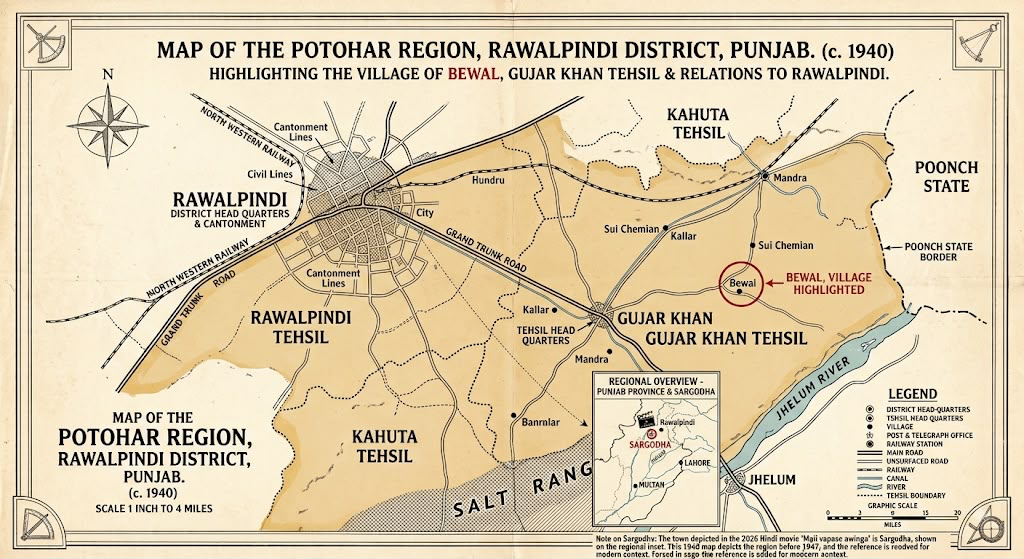
The timing is the part people still get wrong. Bewal sits east of Gujar Khan, with Rawalpindi to the west and the Jhelum beyond. The killing there began in March 1947. The line on the map arrived in August. Partition had not yet been formalised. There was not yet a border to flee across.
What there was, at the start of that month, was a vacuum. The Punjab’s coalition government – the arrangement that had kept an uneasy peace between Muslims, Sikhs and Hindus – collapsed. The League moved into the space. Establishing physical control of Pothohar before any official boundary was drawn was a way of turning facts on the ground into a claim on the territory itself. The villages struck first were those that looked, from outside, like Sikh and Hindu islands in a Muslim countryside. Bewal was one of them.
That is why so many of our families were already gone while the rest of the country was still arguing about dates.
A page like this has to hold things that do not sit comfortably together. A crowd came from the surrounding countryside and burned a Gurdwara. Seventy years later, the Muslim residents of Bewal poured tea and put a garland on the great-grandson of the village landowner. I do not need those facts to cancel each other. The horrors of 1947 show what human beings can become in extraordinary circumstances; they do not give me the right to define the people who welcomed me in 2017 by deeds they did not commit.
A Sikh and Hindu village in the Pothohar hills. A service-minded landowner and hakeem. A poor Muslim girl taken in as a daughter, who later carried a warning to the household. A cousin who tried to exchange inherited stones for his life and was murdered. And a grandson who, in 2017, accepted refreshments outside one house, asked for the loo in another, and only afterwards understood the ground on which he had been standing.