
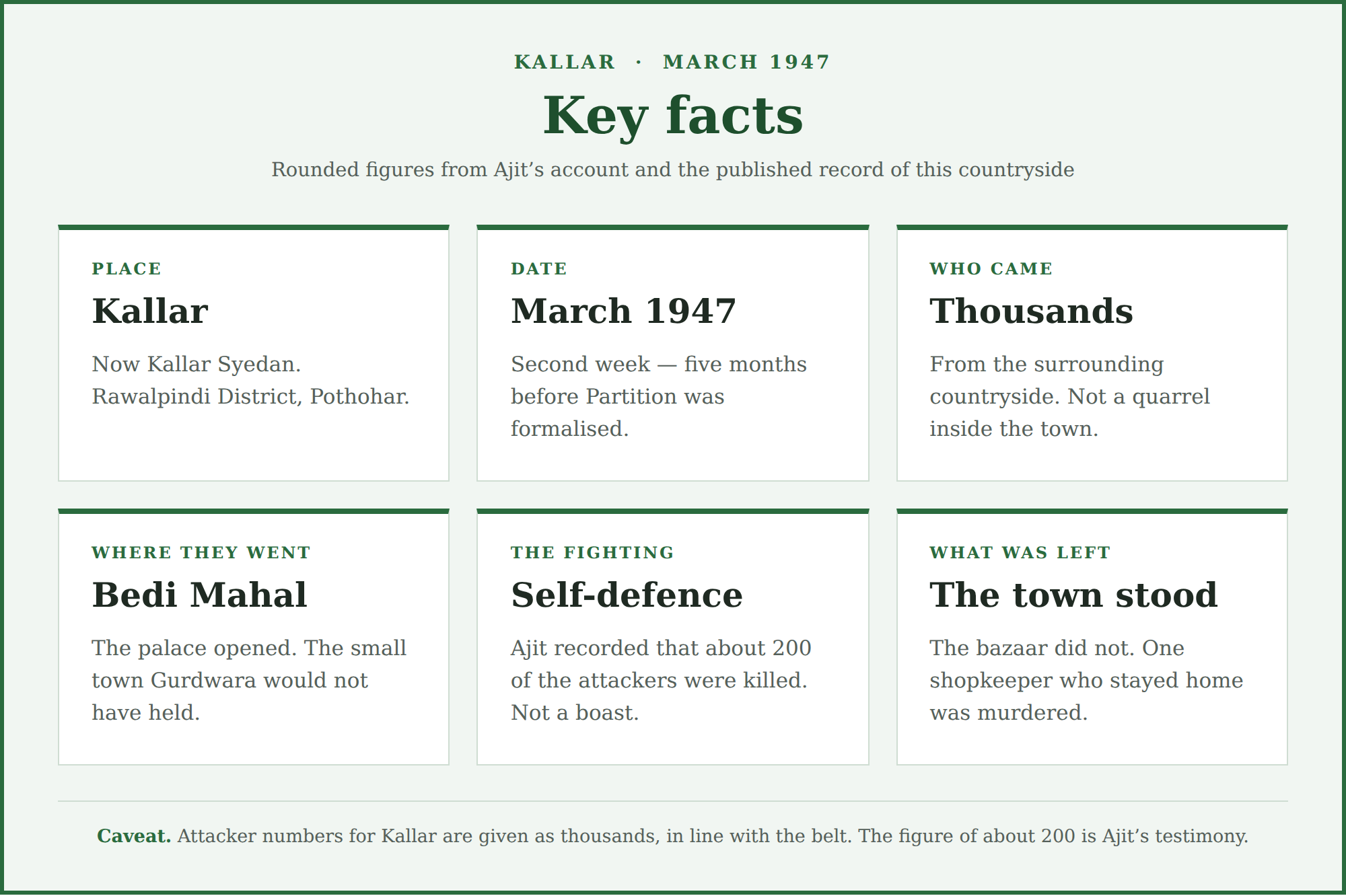
A Pothohari survival story. In March 1947 most of the Sikh and Hindu villages around Rawalpindi were broken open. Kallar defended itself, and the town was still standing.
From the recollection of Ajit Singh Mahajan · Former General Secretary
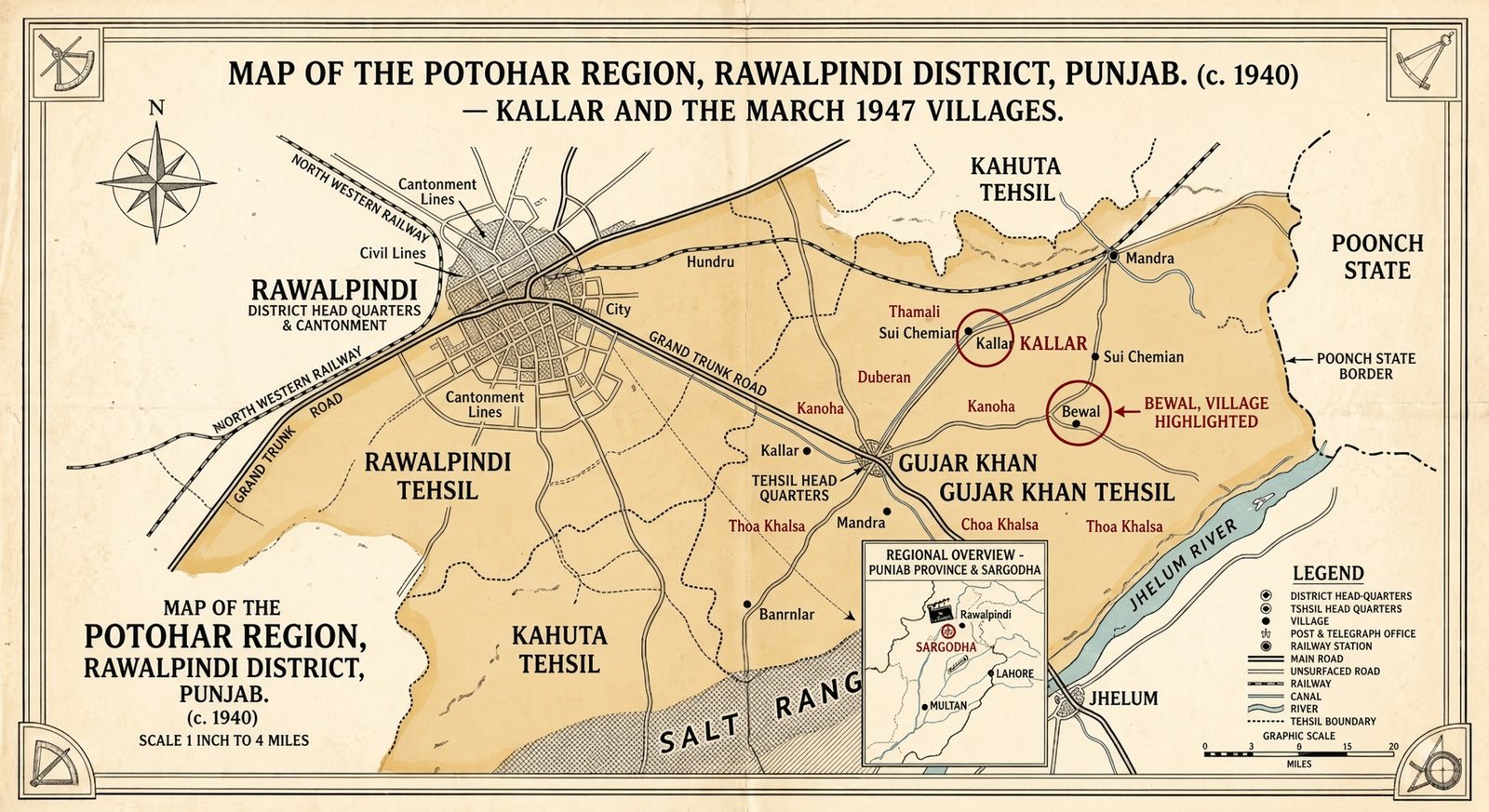
The pattern. In the second week of March 1947, village after village in this belt was overrun. Thamali, Duberan, Choa Khalsa, Thoa Khalsa and many others. The published death-toll for the Rawalpindi countryside runs to several thousand.
Kallar. A town, not a hamlet. Thousands came at it from outside. The bazaar burned. One shopkeeper who stayed behind was murdered. The rest went into Bedi Mahal and defended themselves. That was unusual in this belt.
What that means. Survival here was unusual. Defence here was unusual. That is the story. Not that nobody died. That the town was still standing when the week ended.
How this was written. An Association page on another village — Bewal, Ajit’s nanke, where a cousin was killed — reached him and prompted him to set Kallar down. The cousin’s village is not retold here. There were many such villages.
Long before any border was drawn, this plateau was a web of merchant towns, farming villages and spiritual centres. For a young Ajit Singh Mahajan the map was the spin of a bicycle wheel. From Kallar — then in the Kahuta countryside, now Kallar Syedan — he rode out to Thamali, Duberan, Kanoha, Choa Khalsa. Every year the town walked to the Gurdwara at Kanoha for a festival. In the holidays he went the other way, toward Gujar Khan, to his nanke. That is all that needs saying about that road. This account is the hometown.
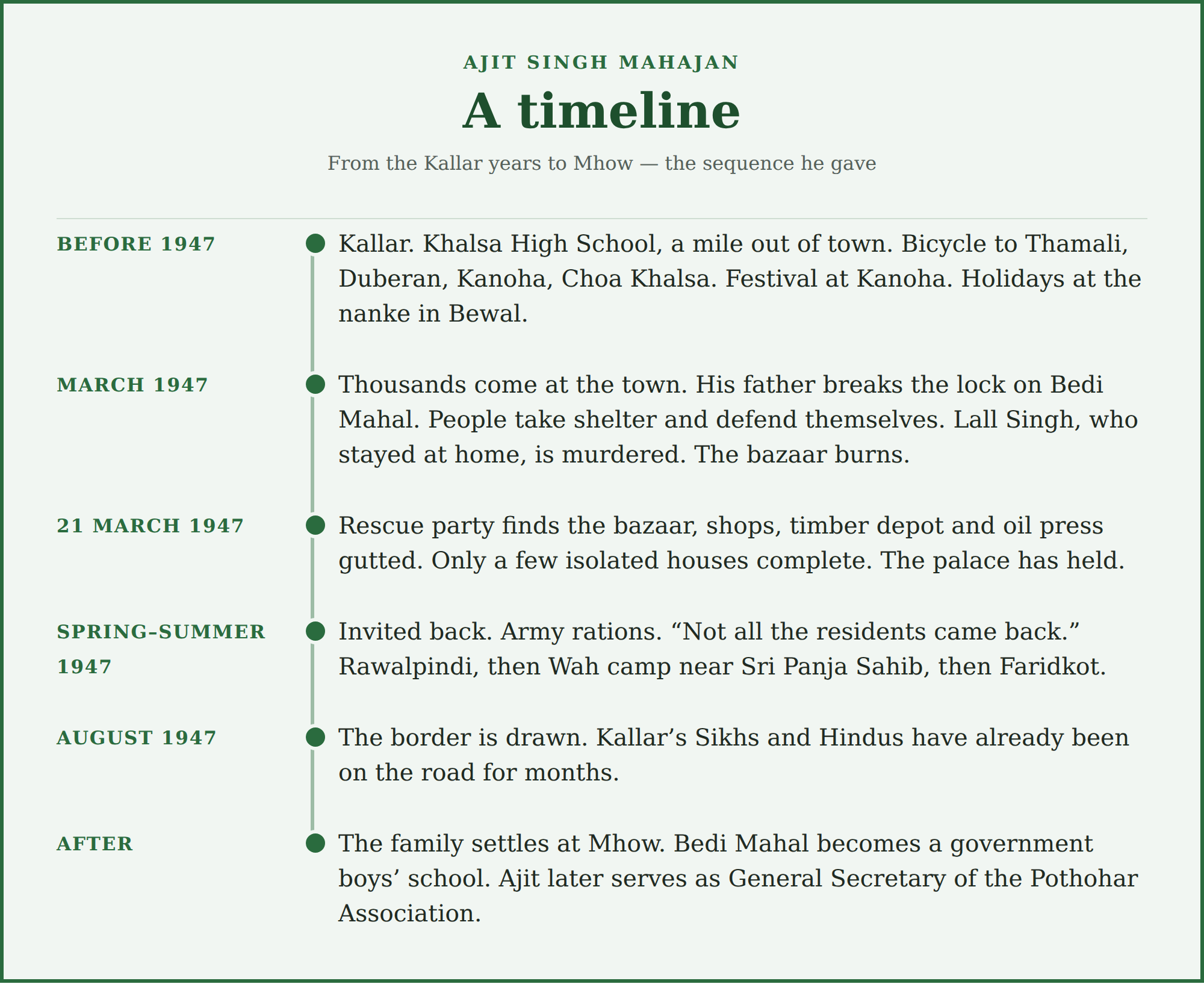
Kallar was a proper town. Two high schools. A girls’ school. Hospital, post office, prison. A bus to Rawalpindi, to Gujar Khan, and into the villages. Sikh merchants ran almost the whole bazaar — later memory says there was barely a Muslim shop on those streets. Every day Ajit walked nearly a mile out of town to Khalsa High School.
That is why what happened here is not the same as what happened in a village of a few hundred. There were walls to get behind. There were a few rifles. There was a house that already knew how to gather people. None of that makes a virtue of the dead. It explains why anyone was left to tell it.
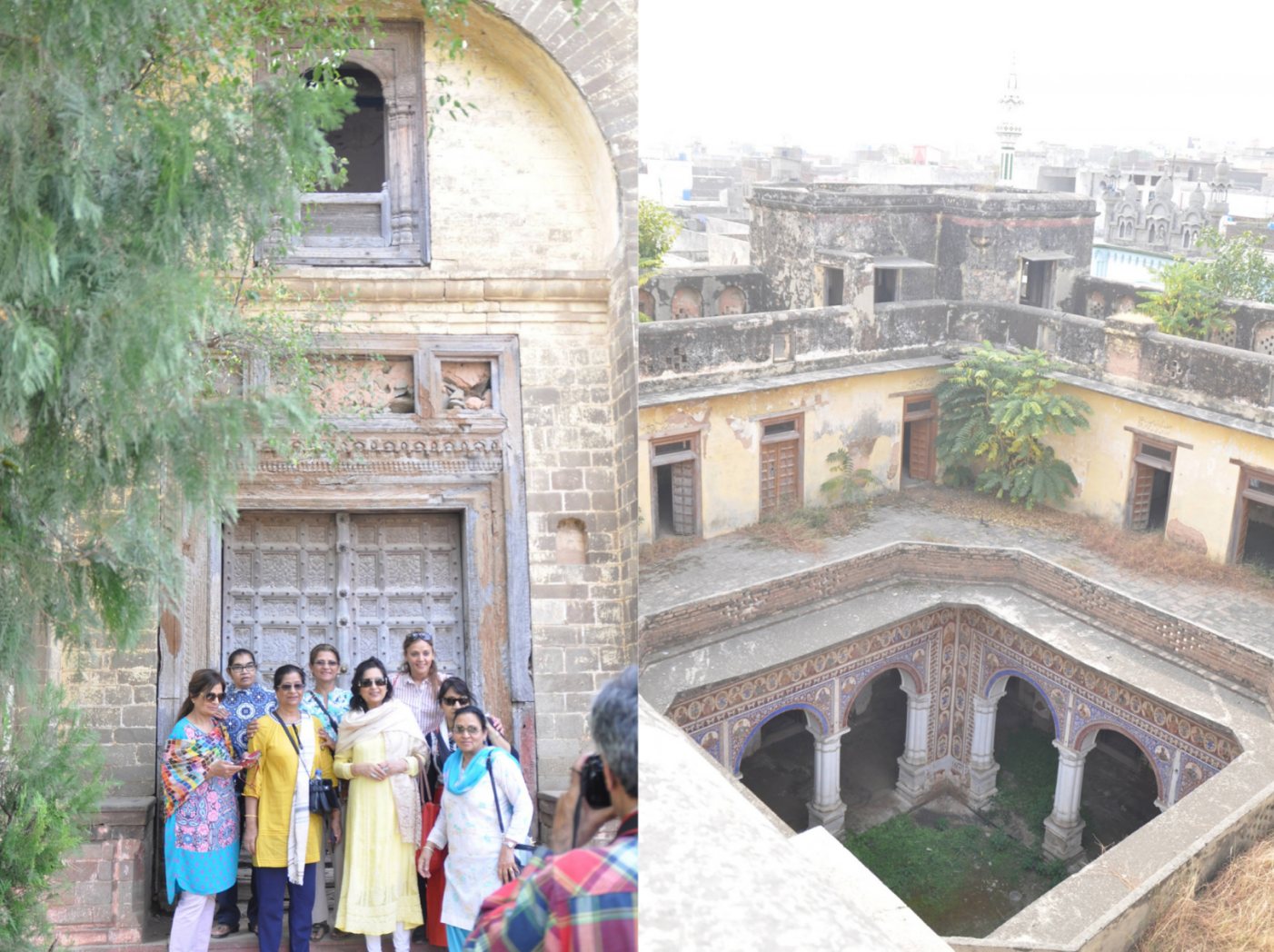
The heart of the town sat above the streets. Bedi Mahal was not a district office with a flag. It was the seat of a family that claimed descent from Guru Nanak. Baba Khem Singh Bedi built it in the mid-nineteenth century — a founder of the Singh Sabha, a landowner, the man who put more than fifty schools into Rawalpindi district and spent the rest on this house. Four storeys. Basements. An orchard. A stable. For a time a small menagerie. A kachahri. Its own Gurdwara inside the walls.
The plaster carried the faith. Frescoes of the Gurus, of the Harmandir, of the old stories, so that a child in that courtyard grew up inside Sikhi as well as under a roof. Come Baisakhi the town lit up and Sikhs came from across the Punjab. This is what people mean when they say Sikhi was kept at Kallar. Not that the religion began here. That a living centre of it — lineage, school, festival, painted hall — stood in this fold of the Potohar and held.
After Khem Singh’s death in 1905 the Pothohar Sikhs looked to his eldest son, whom Ajit remembered as Sir Raja Baba Gurbax Singh. Ajit’s father had been a classmate and friend of Kanwar Nonehal Singh and of Tikka Surinder Singh, the last holder of that seat. That friendship is why a lock could be broken in a crisis by a man the house already knew.
In the second week of March 1947 the coalition ministry in Punjab had just collapsed. The League moved into the space. The villages that looked like Sikh and Hindu islands were hit first, and most of them went the same way: a small Gurdwara, a last roof, fire.
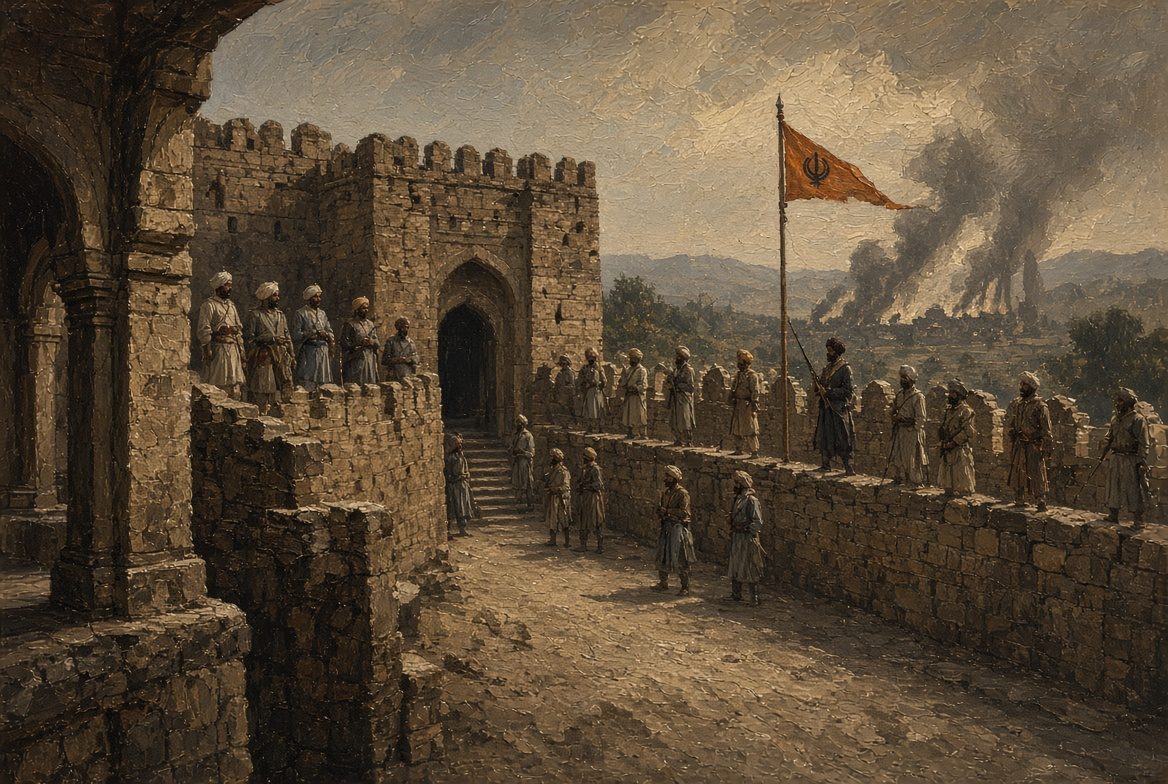
When the mob came close to Kallar, Ajit wrote, the residents first packed into the town Gurdwara. It was a small building. It would not have held. His father took the grandmother and the younger brother to the palace, broke the lock of the main door, and on his own responsibility invited everyone in.
Later memory puts the number inside those walls in the hundreds; some say toward five thousand, people of the town and of the neighbouring villages. The range is uncertain. What is not uncertain is the fact of the opening. The mahal was not put to the torch.
They were not raiding anyone. Several thousand men had come at the town. Behind the palace walls people defended themselves with what they had — Ajit remembered Bawa ji’s rifles, used mostly by his gunman. In that fighting, he wrote, about two hundred of the attackers were killed. That sentence is in his letter because he wanted the members to understand it was not a slaughter of a defenceless street. It is recorded here as self-defence, not as an ethic. Across this belt the record is of Gurdwaras burned, wells, abducted women, streets of the dead. A town that held, and was still a town at the end of the week, is the exception. That is why this page exists.
It was not costless. Lall Singh, who ran a sweet shop, stayed at home. The mob killed him. A rescue party on 21 March found the main bazaar and other shops, houses, a timber depot and an oil-pressing works gutted. “Only a few isolated houses standing complete.” The walls held. The merchant town inside them did not.
What held. Bedi Mahal. The painted Gurus. Enough of the town that the army could invite people back.
What went. The bazaar. The shops. The timber and the oil press. The Sikh merchant life that had been almost the whole street. Fortunes that lived in goods, not in a bank that would transfer.
Who did not return. “We were not happy,” Ajit wrote, “since not all the residents came back.” A town can be reopened and still be finished.
The road out. Rawalpindi for a few days. Wah camp — he wrote Voha — near Sri Panja Sahib, some twelve thousand from this belt. Faridkot camp. Mhow, for good.
They did go back, briefly, on army rations. Then they left. After Partition the mahal became a government boys’ school. The frescoes stayed on the plaster. Other children walked past them. That is also what survival looks like: the building remains; the congregation does not.
Ajit called this his ability — his own. He wrote it so the members would have a town that did not go the way of the others: a father with a classmate’s claim on a palace door, a wall that held against thousands, a bazaar that burned anyway, and a road that started in March and did not stop at August.
Source: Ajit Singh Mahajan, letter to the Pothohar Association.
If your family has memories of Pothohar, the Association would like to hear them.